How to Start a Security Company in North Carolina: A Step-by-Step Guide
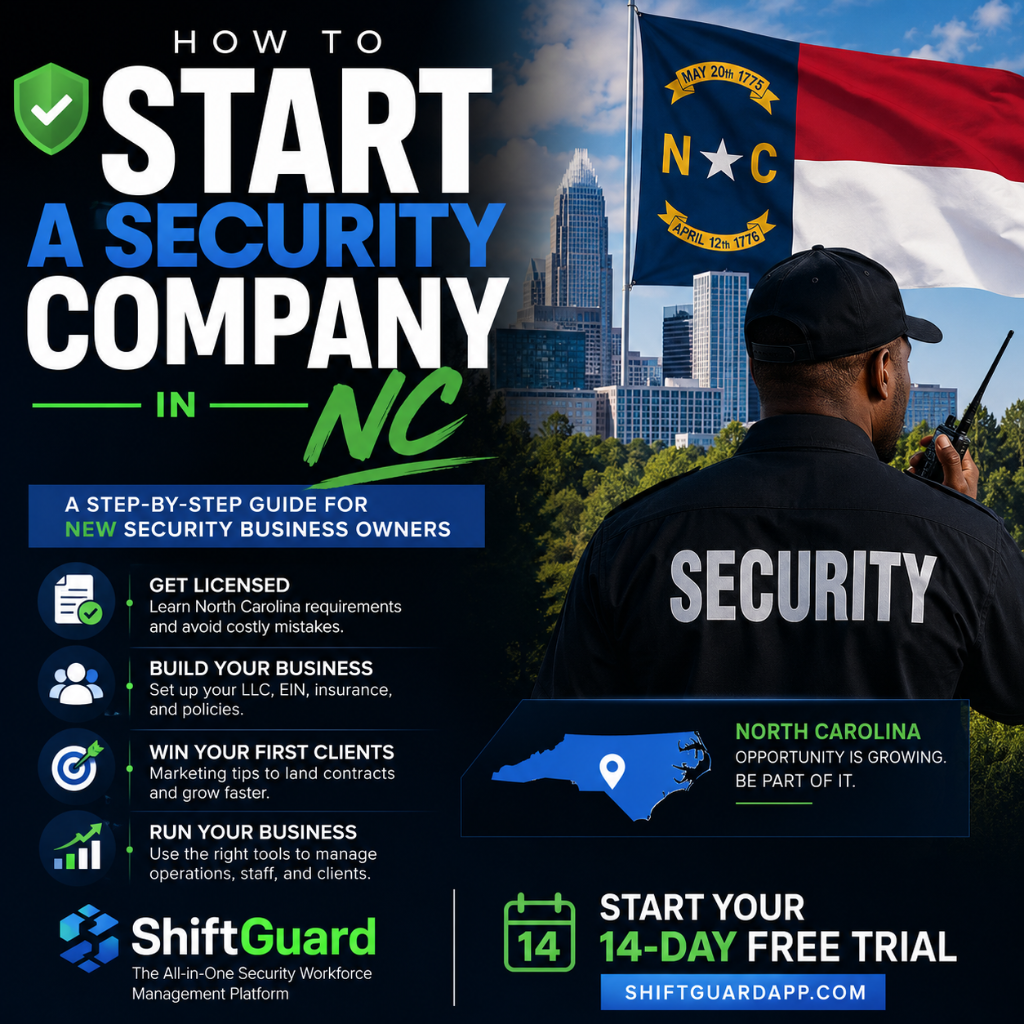
Starting a security company in North Carolina requires licensing, insurance, trained guards, and the right operational tools.
A complete step-by-step guide to starting a security company in North Carolina — covering PPSB licensing, business formation, insurance, hiring guards, winning clients, and running operations with the right software.
Table of Contents
North Carolina is one of the fastest-growing states in the country, and with rapid population growth in cities like Charlotte, Raleigh, Greensboro, and Durham comes rising demand for professional security services. From corporate campuses and residential communities to retail centers and construction sites, businesses across the Tar Heel State need reliable, licensed security providers to protect their people and property.
If you've been thinking about starting a security company in North Carolina, there has never been a better time. But before you print business cards or hire your first guard, you need to understand the state's licensing requirements, business setup process, and operational foundations. This step-by-step guide walks you through everything you need to launch and grow a compliant, profitable security company in NC.
Why North Carolina Is a Strong Market for Security Companies
North Carolina consistently ranks among the top states for population growth and corporate relocation. The Charlotte metro area is the second-largest banking hub in the United States, the Research Triangle (Raleigh-Durham-Chapel Hill) is a global technology and life sciences center, and the state's port, logistics, and manufacturing sectors continue to expand.
That growth translates directly into demand for security services. Property managers need access control and patrol coverage. Construction firms need site security to prevent theft and vandalism. Retailers need loss prevention support. Events, concerts, and sports venues require crowd management. In short, a well-run North Carolina security company has no shortage of potential clients.
The trade-off is that the state regulates the industry closely. The North Carolina Private Protective Services Board (PPSB), operating under the Department of Public Safety, oversees all private security, private investigator, and alarm businesses. To operate legally, you must meet their licensing standards from day one.
1. Understand the North Carolina Private Protective Services Board
In North Carolina, the security industry is regulated by the Private Protective Services Board (PPSB). The Board administers licenses for security firms, registers individual security guards, and enforces the rules that govern training, conduct, and operational standards across the state.
Before you invest in equipment, marketing, or hiring, you should familiarize yourself with the Board's requirements. Operating a security company in North Carolina without the proper firm license and registered guards is illegal and can result in significant fines, criminal charges, and a permanent ban from the industry.
License Types That Matter Most
- Security Firm (Business) License: Required for any company that provides unarmed or armed security guard services for a fee.
- Armed Security Registration: Required for individual guards who carry a firearm on duty. Guards must be at least 21 years old and complete additional firearms training.
- Unarmed Security Registration: Required for individual guards who perform security duties without a firearm. Guards must be at least 18 years old.
The firm license is what allows your business to legally operate. Individual guard registrations are tied to your firm, and every guard you place on a post must be registered through the Board and assigned to your company.
2. Choose Your Business Structure
Before applying for your firm license, you need to establish a legal business entity. Most security company owners in North Carolina choose to form a Limited Liability Company (LLC) because it protects personal assets, offers flexible tax treatment, and is relatively simple to maintain.
Other common structures include:
- Sole Proprietorship: Easiest and cheapest, but offers no personal liability protection.
- Corporation (S-Corp or C-Corp): Useful for larger operations planning to raise outside capital, but with more administrative overhead.
- Partnership: Suitable when two or more owners share responsibility, though an LLC taxed as a partnership often works better.
An LLC is the right choice for most new security companies. It shields your personal savings, home, and vehicles from business liabilities, which is essential in an industry where guards interact with the public and respond to incidents.
Registering Your LLC in North Carolina
To form an LLC in North Carolina, you'll file Articles of Organization with the North Carolina Secretary of State. You'll need to choose a unique business name, designate a registered agent with a physical address in the state, and pay the filing fee. Once approved, you'll receive a charter number that you'll use on license applications, tax filings, and contracts.
3. Get Your EIN and Set Up Business Banking
After your LLC is formed, apply for an Employer Identification Number (EIN) from the IRS. This is free and only takes a few minutes through the IRS website. Your EIN functions like a Social Security number for your business and is required to:
- Open a business bank account
- File federal and state taxes
- Process payroll for guards and office staff
- Apply for business credit cards and loans
Open a dedicated business checking account and keep all company income and expenses separate from your personal finances. Comingling funds can void your LLC's liability protection and creates accounting headaches at tax time. A clean bookkeeping system also makes it easier to demonstrate financial stability to the PPSB, which may review your business records during the licensing process.
4. Meet North Carolina Security Firm Licensing Requirements
This is the most critical step. To legally provide security services in North Carolina, your company must hold a Security Firm License issued by the PPSB. The application process is detailed and requires documentation, background checks, and proof of qualifications.
The Qualifying Agent Requirement
Every licensed security firm in North Carolina must designate a Qualifying Agent. This is the individual responsible for the firm's compliance and operations. The Qualifying Agent must:
- Be at least 21 years old
- Be a U.S. citizen or legal resident
- Have a clean criminal history (felonies and certain misdemeanors can disqualify you)
- Demonstrate relevant experience, typically at least three years of supervisory or investigative experience in the security, law enforcement, or military field
- Pass a comprehensive background investigation including fingerprinting
If you don't yet have the experience required to serve as Qualifying Agent, you have two options: partner with someone who does, or spend time working in the industry first to build the required background. The Board takes this requirement seriously and verifies every claim.
Application Components
A complete North Carolina security firm license application typically includes:
- Completed firm license application form
- Articles of Organization or incorporation documents
- Qualifying Agent designation and experience documentation
- Fingerprint cards and background check authorization for all owners and the Qualifying Agent
- Proof of $25,000 surety bond (a Board requirement for all licensed firms)
- Certificates of insurance for liability and workers' compensation coverage
- Application and licensing fees
Processing times vary, but you should expect several weeks to a few months between submitting a complete application and receiving your license. Plan your launch timeline accordingly, and never begin operating — or signing client contracts — until your firm license is formally issued.
5. Satisfy Insurance and Bond Requirements
Insurance isn't optional in the security industry. Clients will require it, the PPSB requires it, and it's the financial backbone that protects your company when something goes wrong on a post.
Required Coverage
- General Liability Insurance: Covers bodily injury and property damage claims arising from your operations. Most clients require at least $1 million in coverage.
- Professional Liability (Errors & Omissions): Covers claims related to failures in performing security duties.
- Workers' Compensation: Required in North Carolina once you have three or more employees. Security is a physically demanding job, and workers' comp protects both your guards and your business.
- Commercial Auto Insurance: Required if you operate patrol vehicles or transport guards and equipment.
- $25,000 Surety Bond: A PPSB requirement that guarantees your firm will comply with state laws and compensate clients for losses caused by violations.
Work with an insurance broker who understands the security industry. A generalist agent may underinsure you or miss coverage that specific clients (like federal contractors or healthcare facilities) require. The right coverage is also a selling point — many clients choose the provider with the strongest insurance profile.
6. Hire and Register Your Security Guards
Once your firm is licensed, every guard you hire must be individually registered with the PPSB and assigned to your company. You cannot place an unregistered guard on a post in North Carolina.
Guard Registration Requirements
- Be at least 18 (unarmed) or 21 (armed) years old
- Be a U.S. citizen or legal resident
- Pass a criminal background check with fingerprinting
- Complete the Board-approved training requirements
- Complete firearms training and qualification for armed registration
The Board requires a minimum number of training hours covering topics like legal authority, use of force, observation and reporting, emergency response, and ethics. Armed guards must complete additional firearms training and pass a qualification course. Maintain training records for every guard — the PPSB can audit your firm at any time.
Beyond compliance, hire guards who reflect the professionalism your clients expect. Background checks, drug screening, and reference verification should be standard in your hiring process. A single bad hire can cost you a contract and damage your reputation in the local market.
7. Build Your Operational Foundation
Compliance gets you licensed; operations keep you in business. Before you sign your first client, you need systems for scheduling, dispatching, reporting, payroll, and communication. Many new security companies try to run on paper logs, group texts, and spreadsheets — and quickly become overwhelmed as they add guards and sites.
Your operational foundation should cover:
- Scheduling: Assign guards to posts and shifts without conflicts or gaps.
- Dispatch and Open Shifts: Fill last-minute callouts quickly.
- Clock-In and GPS Verification: Confirm guards arrived on time and at the correct location.
- Patrol and Checkpoint Tracking: Verify rounds were completed.
- Incident and Daily Activity Reporting: Document everything that happens on a post.
- Client Communication: Share reports, invoices, and updates transparently.
- Payroll: Track hours, overtime, and rates accurately.
This is where modern security management software becomes essential. Running these workflows manually is slow, error-prone, and hard to scale. Platforms like ShiftGuard consolidate scheduling, GPS clock-in, patrols, reporting, invoicing, and payroll into one system designed specifically for security companies.
8. Invest in Equipment and Uniforms
Clients form their first impression of your company the moment a guard walks onto their property. Professional uniforms, clean vehicles, and reliable equipment signal competence and build trust.
Essential Equipment
- Uniforms with company insignia and guard identification
- Two-way radios or communication devices
- Flashlights, notebooks, and basic duty gear
- Patrol vehicles (if offering mobile patrol services)
- Body cameras (increasingly requested by corporate and retail clients)
- Digital reporting tools — most modern guards use a smartphone app to log activities and capture photos
Standardize your uniforms and equipment across your workforce. Inconsistency makes your company look disorganized and makes it harder to manage inventory. Many clients include uniform standards in their contracts, so clarify expectations during the sales process.
9. Market Your Security Business and Win Your First Clients
With licensing, insurance, guards, and equipment in place, you're ready to land clients. Security is a relationship-driven business — most contracts are won through direct outreach, referrals, and a strong local reputation rather than passive advertising.
Effective Marketing Channels
- Direct Outreach: Identify property managers, construction firms, retail centers, HOAs, and event venues in your service area and reach out directly.
- Local SEO: Build a professional website optimized for terms like "security company Charlotte NC" or "construction site security Raleigh." A blog with helpful content boosts your search rankings.
- Networking: Join local chambers of commerce, building owners and managers associations, and construction industry groups.
- Referral Program: Offer existing clients incentives for referring new business.
- Proposal Quality: Your proposals should clearly define services, coverage hours, rates, insurance, and reporting — professionalism here wins contracts.
Focus on a niche when you start. Rather than trying to serve everyone, become the go-to provider for construction site security, or residential community patrols, or corporate campus security in a specific city. Specialization makes your marketing sharper and your operations easier to standardize.
10. Run Your Business with Security Management Software
The difference between a security company that survives and one that scales comes down to systems. As you add guards, sites, and clients, the administrative burden grows exponentially. Without the right tools, you'll spend your evenings reconciling timesheets, chasing down missing reports, and fielding client complaints about coverage gaps.
A purpose-built security management platform eliminates that friction. With ShiftGuard, North Carolina security companies get a single system for:
- Scheduling and open shift management — assign guards, fill callouts, and prevent double-booking.
- GPS clock-in with geofencing — verify guards are on-site at the assigned time and location.
- Patrol routes and QR checkpoint scanning — confirm rounds were completed at each post.
- Daily activity reports and incident reports — digital, time-stamped, and instantly shareable with clients.
- Client portals — give clients real-time visibility into activity, reports, and invoices.
- Payroll and invoicing — track hours, overtime, and billable rates without manual spreadsheets.
The right software also helps you stay compliant. Training records, license expiration reminders, document acknowledgments, and guard onboarding workflows are all built in, so you're always ready for a PPSB audit or a client due diligence review.
11. Stay Compliant and Position Yourself for Growth
Licensing isn't a one-time event. Guard registrations expire and must be renewed. Training must be kept current. Insurance policies need to stay active. The PPSB can inspect your operations and review records at any time, and clients increasingly require proof of compliance as part of their vendor management programs.
Build compliance into your weekly operations:
- Track every guard's license and training expiration dates.
- Maintain signed acknowledgments for post orders, policies, and company handbooks.
- Keep digital copies of incident reports, DARs, and client communications.
- Review insurance coverage annually and increase limits as you take on larger contracts.
- Document onboarding for every new hire — background checks, training completion, and equipment issued.
As you grow, consider expanding into adjacent services: mobile patrol, event security, executive protection, or alarm response. Each new service line may require additional licensing or training, so verify requirements with the PPSB before marketing new capabilities.
Conclusion: Launch with Confidence
Starting a security company in North Carolina is a real opportunity, but it's not a shortcut. The state's licensing requirements exist to protect clients, the public, and the reputation of the industry as a whole. By following the steps in this guide — forming your business, securing your firm license, hiring registered guards, building operational systems, and investing in the right technology — you set yourself up for a compliant, profitable launch.
The companies that win in North Carolina aren't the ones with the lowest prices. They're the ones that deliver consistent coverage, clean reporting, and professional communication every single shift. That's exactly what ShiftGuard was built to enable. Start your 14-day free trial and see how the right platform can transform the way you run your security business.
Frequently Asked Questions
How long does it take to get a security company license in North Carolina?
After submitting a complete application with all required documentation, background checks, and proof of insurance and bonding, processing typically takes several weeks to a few months. You should not begin operating or signing client contracts until your firm license is formally issued by the Private Protective Services Board.
How much does it cost to start a security company in NC?
Startup costs vary widely, but you should budget for LLC formation fees, the PPSB firm license application fee, a $25,000 surety bond, general liability and workers' compensation insurance premiums, uniforms, equipment, training, and software. Most new security companies in North Carolina invest between $10,000 and $30,000 to launch responsibly.
Do I need a surety bond to operate a security company in North Carolina?
Yes. The North Carolina Private Protective Services Board requires all licensed security firms to maintain a $25,000 surety bond. This bond guarantees compliance with state laws and provides financial recourse for clients if your firm violates regulations.
Can armed security guards work in North Carolina?
Yes, but armed guards must hold an Armed Security Registration through the PPSB. They must be at least 21 years old, complete Board-approved firearms training, and pass a qualification course. The employing firm must also hold the appropriate firm license.
What experience do I need to be a Qualifying Agent in NC?
The designated Qualifying Agent for a North Carolina security firm typically must demonstrate at least three years of relevant supervisory or investigative experience in the private security, law enforcement, or military field. The PPSB verifies all experience claims during the application process.
Do my security guards need to be licensed individually?
Yes. Every guard placed on a post in North Carolina must be individually registered with the PPSB and assigned to your licensed firm. Guards must meet age, citizenship, background, and training requirements before they can work.
Start your 14-day free trial with ShiftGuard
Join security companies already using ShiftGuard to streamline scheduling, patrols, reporting, and billing.
No credit card required · 14-day free trial